Choose the question before the display
Someone entering a mill for the first time may not know whether olive oil is pressed, cooked or separated from a mixture. A long wall of technical information can leave that uncertainty intact. Begin with a small set of questions: where does the fruit arrive, what happens to it, where does the oil go, and why are some spaces kept separate?
Those questions can organise the route. The first view establishes the landscape and arrival. The next introduces transformation. A protected boundary explains storage, and a tasting setting connects the process to personal observation. This is not a compulsory sequence for every building. It is a test of whether the visit has an intelligible beginning, development and conclusion rather than a collection of unrelated attractions.
Teach at the threshold
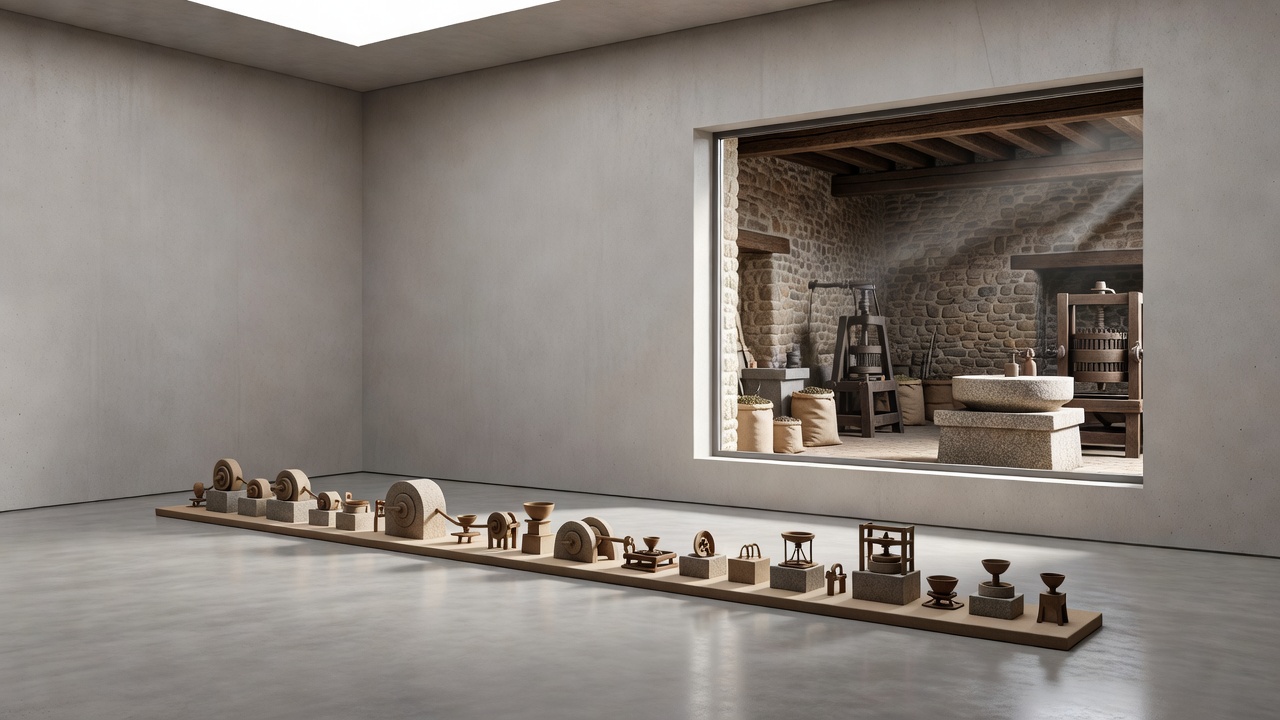
A doorway or window is a useful place to explain why one activity stops and another begins. Instead of treating the production boundary as an inconvenience, describe its purpose in plain language. The visitor can understand that working routes, cleaning routines and product protection impose conditions that do not apply to the public gallery. Separation becomes part of the lesson.
Use annotated sections where a plan would be too abstract. A section can show the arrival canopy, the mill floor, service access and the viewing position in one image. Keep the first layer simple enough to read quickly. Add optional detail for the visitor who wants to know more, rather than requiring everyone to decode the same dense drawing.
Make the quiet season meaningful
The harvest is seasonal, while an educational programme may run throughout the year. A route dependent on working machinery can become a corridor of silent objects. Prepare an alternative explanation using short captioned recordings, robust models, material samples and clear before-and-after diagrams. Distinguish recorded activity from what is actually happening during the visit, especially when children are interpreting the scene.
Historic mill museums offer useful interpretive comparisons. The Musée de l’Olivier at Volx, the Musée de l’Huile d’Olive at Nyons and the Museum of the Olive and Greek Olive Oil in Sparta place tools, labour and regional history within a visitor narrative. They are not substitutes for contemporary operating-mill guidance, but they demonstrate that learning does not depend on a machine running in front of an audience.
The visitor should leave able to explain a relationship, not merely remember a room.
Offer more than one way to understand
Not everyone reads quickly, hears a guide clearly or feels comfortable in a crowded group. Pair concise text with drawings, spoken explanation and physical models where appropriate. Provide a place to pause without losing the route. A seated visitor should not have to look through other people to see the only useful diagram. Check how information works from several heights and positions.
A school visit also needs practical staging. Where can a group gather before entering? Where do coats and bags go? Can the teacher hear a question without blocking a doorway? A modest briefing area can prevent the public entrance becoming a congested classroom. Group size, supervision and safeguarding arrangements belong to an actual operating plan, developed with the responsible organisation rather than improvised by the architecture alone.
Leave room for a question
The route should not end with the assumption that every visitor has reached the same conclusion. A small discussion table, a map to annotate or a prompt beside the exit can invite reflection. Ask visitors which boundary they noticed, what surprised them about storage, or how the building changed their understanding of labour. These questions make architecture part of the subject rather than decorative scenery.
Finally, provide a clear return path. Shops and hospitality can be valuable, but a visitor should be able to find the exit, facilities and meeting point without navigating an implied sales obligation. The strongest educational architecture is generous in this simple sense: it gives people enough structure to learn, enough choice to participate, and enough clarity to leave with an idea they can explain to someone else.